Local electrical repair services in Suffolk County that save you money
Professional electrical repair services in Suffolk County focus on fast, accurate diagnosis, returning systems to safe operation, and stopping repeat problems that drive up long‑term costs. This guide walks through the most common local repair needs, shows how professional repairs and preventative maintenance lower lifetime expenses, and explains when an issue becomes an emergency requiring immediate attention. You’ll find practical warning signs to watch for, how panel and system upgrades reduce outage and repair risk, and the cost impact of EV charger and generator transfer‑switch installations for homes and businesses. Each section gives clear examples, priority action steps, and concise comparisons so you can make informed choices about repairs, upgrades, and maintenance. We also point out Suffolk County specifics and where licensed, code‑compliant work produces measurable savings.
What are the most common electrical repairs in Suffolk County?
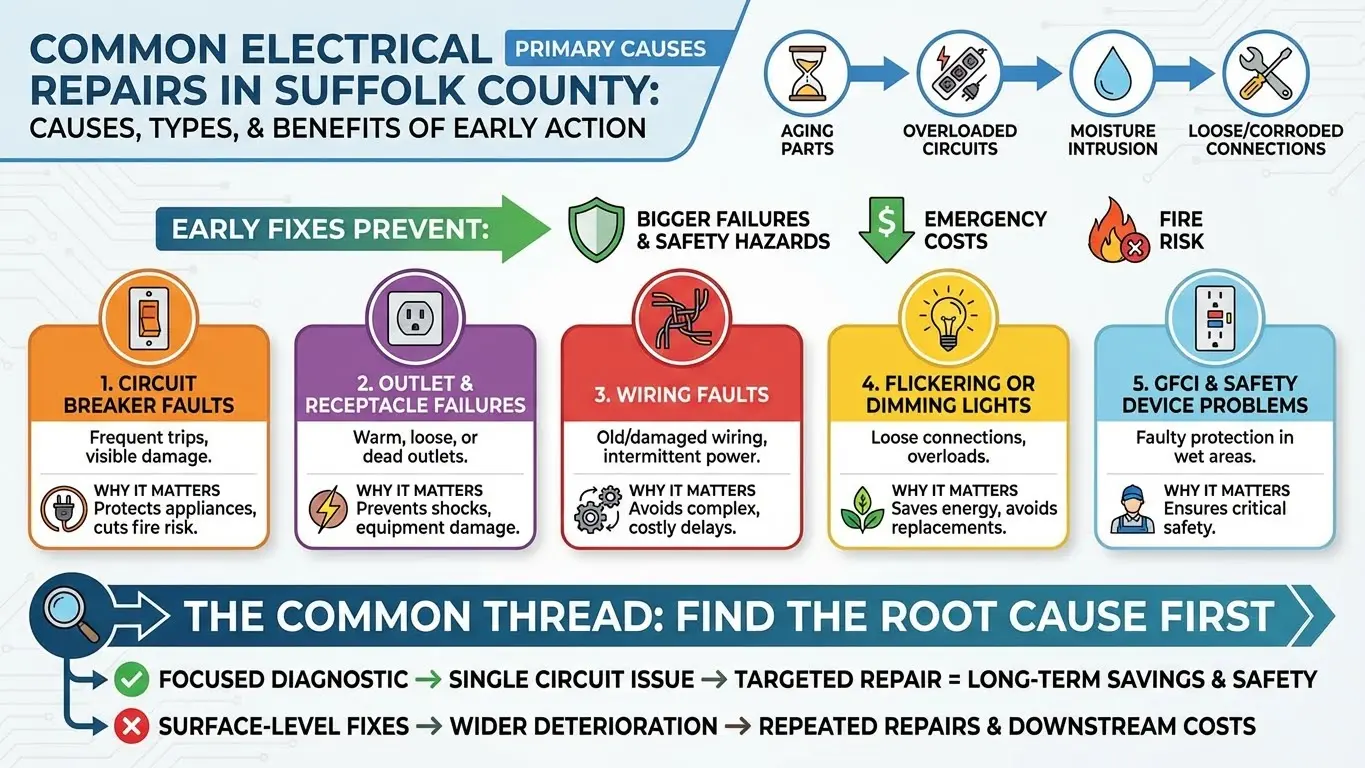
Most local repairs come from aging parts, overloaded circuits, moisture intrusion, and loose or corroded connections. Tackling those problems early prevents bigger failures and safety hazards. A focused diagnostic finds whether an issue is limited to a single circuit or is a symptom of wider panel or wiring deterioration—an important factor for repair cost and long‑term savings. Early fixes reduce the chance of damaging appliances, lower fire risk, and avoid emergency work that costs more in labor and replacement parts. Below are the top repair types and why they matter for homeowners and businesses, followed by how breaker work prevents larger damage.
- Circuit breaker faults: Frequent trips or visible damage point to overloads or failing breakers. Fixing them protects appliances and cuts fire risk.
- Outlet and receptacle failures: Warm, loose, or dead outlets usually signal wiring or connection issues that can lead to shocks or equipment damage.
- Wiring faults: Old or damaged wiring causes intermittent power, arcing, and reduced capacity—making repairs more complex and costly if delayed.
- Flickering or dimming lights: These often indicate loose connections, overloaded circuits, or failing fixtures—issues that waste energy and can force fixture replacements.
- GFCI and safety device problems: Faulty GFCIs remove important protection in wet areas; they should be tested and, when needed, replaced by a pro.
The common thread: find the root cause first. That approach saves money compared with repeated, surface‑level fixes and prevents downstream costs from damaged equipment or code‑required remediation.
How do circuit breaker repairs prevent costly electrical failures?
Circuit breakers protect wiring and equipment by cutting power when conditions are abnormal. Repairing or replacing failing breakers restores that protection and prevents larger failures. Breaker failures often come from worn trip mechanisms, corrosion, or overheating—issues a professional can diagnose to decide between replacement or load redistribution. Fixing the breaker stops nuisance trips that push homeowners to overload other circuits or use temporary extensions—practices that create hazards and extra wear. For example: a breaker that trips during heat spells is often solved by rebalancing loads and a targeted repair that costs far less than replacing appliances or repairing fire‑damaged wiring.
Correct breaker work also helps preserve appliance life and keeps you compliant with insurance requirements—important when weighing long‑term costs against immediate repair bills. Checking breaker health naturally leads to inspecting outlets and wiring for related problems.
What signs indicate faulty outlets and wiring issues?
Faulty outlets and wiring usually show up as warm receptacles, intermittent power, visible sparks, burning smells, or outlets that don’t hold plugs securely. Each of these signs needs quick attention to limit damage. Warm or discolored outlets point to loose connections or overloaded circuits that raise resistance and heat, accelerating deterioration and increasing fire risk. Intermittent power and sparks suggest arcing, a hazardous condition that progressively harms conductors and connected devices; letting arcing continue raises repair complexity and cost. If you see any of these signs, stop using the affected outlet, unplug sensitive equipment, and schedule a professional inspection—don’t try DIY fixes that can hide the real problem and make repairs costlier later.
Spotting these warnings helps you prioritize repairs and decide whether a simple outlet replacement or a broader wiring remediation is needed—further evidence of how professional work saves money over time.
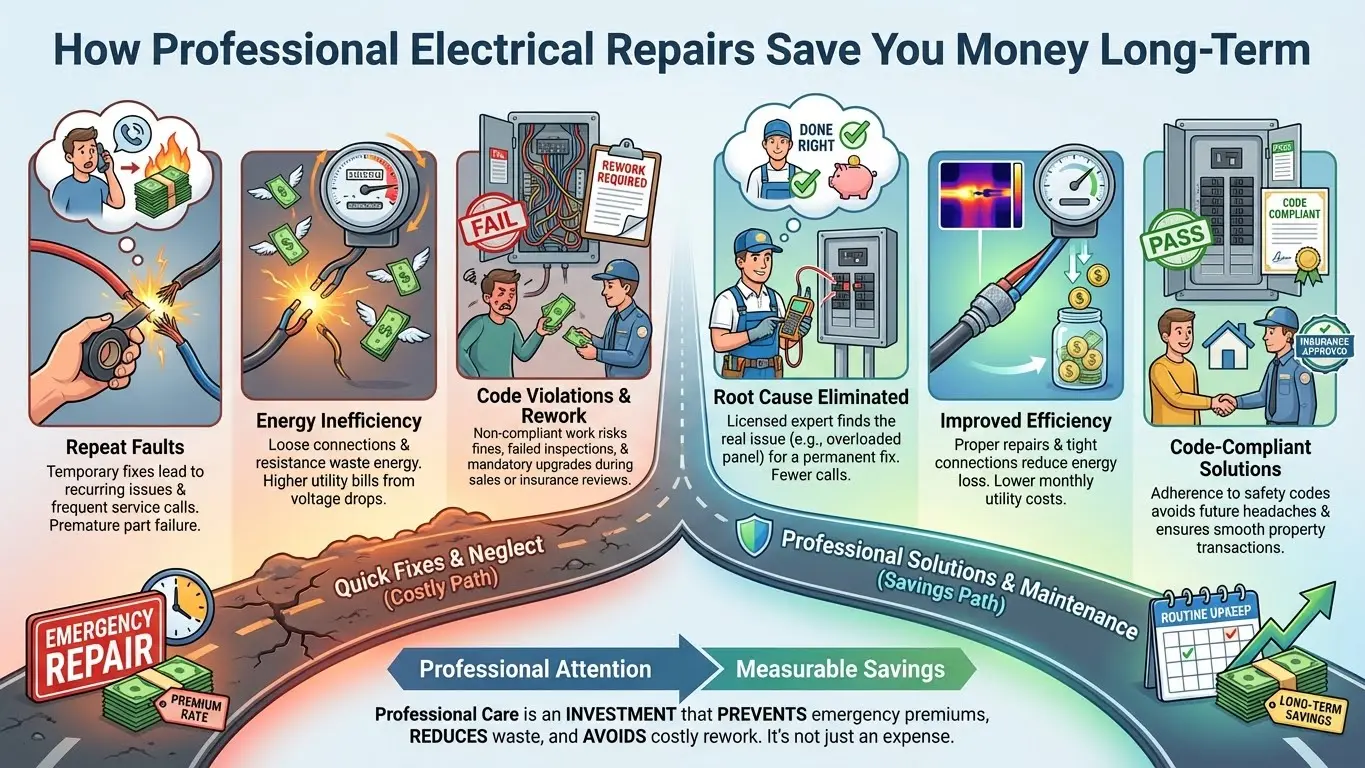
How can professional electrical repairs save you money long‑term?
Professional repairs save money over time by eliminating repeat faults, improving energy efficiency, and delivering code‑compliant solutions that avoid costly rework or insurance headaches. A licensed electrician finds the root cause—overloaded panels, degraded wiring, or poor connections—so the job is done right the first time, cutting repeat service calls and premature part failures. Proper repairs and preventive maintenance also reduce energy losses from voltage drops and loose connections, lower utility costs, and prevent emergency scenarios that carry premium after‑hours rates. Below are clear ways professional attention turns into measurable savings.
- Preventing emergency repairs: Routine upkeep avoids premium emergency labor and expedited parts costs.
- Reducing energy losses: Tight connections and correct wiring lower resistance and energy waste on heavily loaded circuits.
- Avoiding code‑related rework: Code‑compliant fixes remove the need for later mandatory upgrades during sales, inspections, or insurance reviews.
These mechanisms show why licensed, methodical repairs are an investment—not just an expense. Next, we explain why hiring a licensed electrician matters when you want cost‑effective work.
Why choose a licensed Master Electrician for safe and affordable repairs?
A licensed Master Electrician brings verified training, up‑to‑date code knowledge, and hands‑on diagnostic experience that reduce the chance of incomplete or unsafe repairs that cause repeat service and higher lifetime costs. Licensing means they know local codes and safe practices, which prevents non‑compliant work that can lead to expensive corrections or denied insurance claims. Experienced electricians see subtle signs of deeper system issues. Choosing a licensed pro favors “right‑first‑time” repairs: accurate diagnosis, correct parts, and workmanship that cuts callbacks and extends component life. In cost terms, that means fewer emergency visits, lower total labor hours, and better protection for appliances and property value.
The value of licensing becomes even clearer when you factor in regular maintenance and targeted prevention that reduce future repair needs.
How does preventative electrical maintenance reduce future repair costs?
Preventative maintenance catches wear, loose connections, and early degradation before they fail catastrophically. Typical tasks include panel inspections, thermal imaging to spot hot spots, tightening connections, testing GFCIs and AFCIs, and load analysis to reveal overloaded circuits—each is comparatively low cost versus emergency replacements or fire damage. A scheduled inspection that finds a loose bus connection, for example, can save thousands by avoiding breaker failure and downstream wiring replacement. Regular maintenance also helps homeowners and businesses plan upgrades over time, smoothing capital expenses and preventing urgent, high‑cost interventions.
A preventive maintenance strategy is essential for balancing upkeep costs with resilience and reliability—and for showing the cost‑benefit of timely electrical care.
Cost‑Benefit Analysis of Preventive Maintenance for Electrical Networks
This study uses a preventive maintenance strategy to compare the costs of upkeep, resilience, and reliability. It analyzes reliability and resilience under multiple scenarios, presents system resilience diagrams for different accident severities, and selects the best preventive approach based on simulations. The findings support a maintenance plan that improves distribution network resilience and reliability after incidents and demonstrates the economic justification of the proposed strategy. Providing a preventive maintenance strategy for enhancing distribution network resilience based on cost–benefit analysis, ME Hajiabadi, 2023
Routine maintenance also supports insurance and safety documentation, which can influence premiums and resale value—tying preventative care directly to long‑term financial benefits.
When should you call for emergency electrical repair services in Suffolk County?
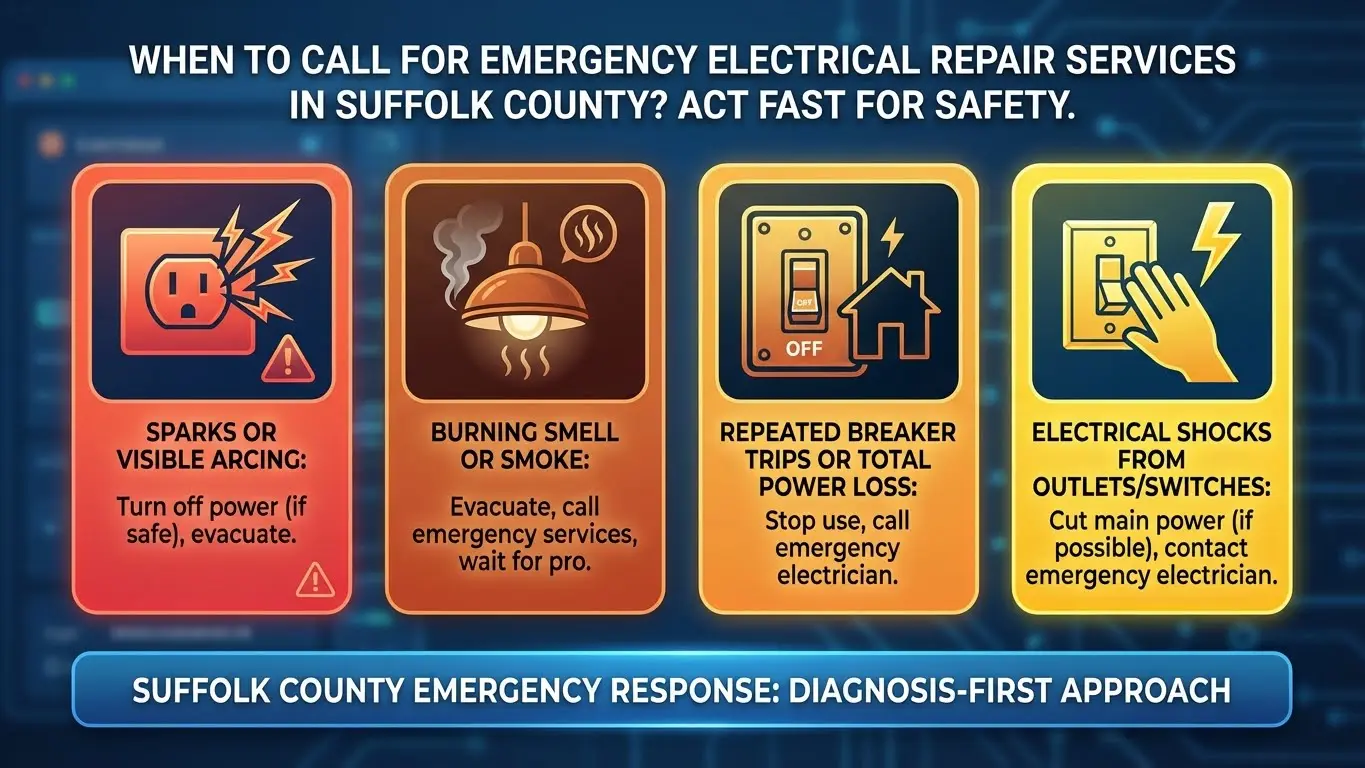
Knowing what counts as an electrical emergency helps you act quickly to protect people and property. Immediate‑response situations require stopping use of affected systems and calling a qualified emergency electrician. Emergencies include active sparking, persistent burning smells, repeated unexplained breaker trips, total power loss to a building, or any event that causes electrical shock. These conditions can escalate fast to fire or equipment destruction, so safety comes first—turn off affected circuits only if it’s safe, evacuate if you smell burning or see smoke, and call for emergency help. Below are the most common warning signs and the immediate actions to take.
- Sparks or visible arcing: Turn off power if it’s safe and evacuate the area; have a professional perform a safe shutdown and repairs.
- Burning smell or smoke: Evacuate, call emergency services if needed, and don’t re‑enter until a pro confirms it’s safe.
- Repeated breaker trips or total power loss: Stop using appliances that trigger trips and call an emergency electrician to find the root cause.
- Electrical shocks from outlets or switches: Cut power at the main if possible and contact an emergency electrician—shocks indicate hazardous faults.
Knowing these priorities makes it easier to decide when to call for emergency service and what information to share. Next we explain how local licensed providers respond and what to expect from a diagnosis‑first repair approach.
What are the warning signs that require immediate electrical attention?
Warning signs needing urgent attention include persistent burning odors, visible flames or smoke, uncontrolled arcing, and anyone getting shocks from fixtures or wiring. Each carries a high risk of escalating damage—burning smells often mean overheating components or insulation failure that can ignite, while shocks indicate exposed conductors or failed grounding. If any of these occur, don’t handle wires or repeatedly reset breakers without knowing the cause. Prioritize safety by evacuating if needed. When you call for emergency help, be ready to describe symptoms, affected areas, recent electrical work, and whether smoke or fire is present—this helps technicians bring the right tools and speed up diagnosis.
Clear, immediate descriptions let responders prepare appropriate safety gear and parts, which shortens repair time and limits how long systems remain unsafe.
How does RJ & Son Electric provide fast and reliable emergency repairs?
RJ & Son Electric is a licensed and insured Master Electrician service serving Suffolk County. We focus on quick, safety‑first diagnostics to determine whether a problem is isolated or a symptom of a larger system issue, then deliver safe, code‑compliant repairs that prevent repeat failures. Our local experience with common Suffolk County wiring conditions helps us make targeted, efficient repairs that cut downtime and overall costs. For urgent help, contact RJ & Son Electric at 631-833-7663 or through our website or Google Business Profile to request immediate service.
Our emphasis on licensed workmanship and fast diagnostics helps minimize emergency costs by fixing root causes efficiently and safely.
What residential and commercial electrical repair services are available locally?
Local electricians offer a range of residential and commercial services to fix common faults, improve safety, and lower operating costs through repairs, upgrades, and planned maintenance. Residential work centers on occupant safety, energy efficiency, and protecting appliances. Commercial services prioritize uptime, code compliance, and phased scheduling to avoid business disruption. Below is a practical mapping of common services to typical problems and the money‑saving outcomes they deliver for homeowners and businesses, followed by short summaries of residential and commercial priorities.
| Service | Typical Problem | Typical Benefit / Outcome |
|---|---|---|
| Electrical repairs & troubleshooting | Tripped breakers, intermittent power, warm outlets | Fast diagnosis restores safe circuits and prevents appliance damage |
| Panel upgrades | Overloaded panels, frequent trips | Increased capacity, fewer outages, supports new loads like EV chargers |
| EV charger installation | Inconsistent vehicle charging, public charging costs | Lower per‑mile cost and home charging convenience |
| Generator transfer switch installation | Unsafe generator hookup during outages | Code‑compliant backup power, prevents backfeeding and damage |
How do residential electrical repairs improve home safety and efficiency?
Residential repairs improve safety and efficiency by replacing worn components, restoring proper grounding and bonding, and correcting load imbalances that waste energy or risk damage. Homeowner benefits include reduced fire risk from fixed connections, longer appliance life thanks to stable voltage and proper circuits, and lower energy bills when faulty wiring or devices are corrected. Simple upgrades—like replacing bad GFCIs or addressing old knob‑and‑tube or aluminum branch circuits where applicable—prevent costly failures and insurance problems. For many homeowners, targeted repairs and preventive checks provide immediate safety improvements and long‑term savings by avoiding emergency work and improving energy performance.
System assessments also reveal opportunities for staged upgrades—spreading expense while delivering incremental efficiency and safety gains.
What commercial electrical repair solutions minimize business disruption?
Commercial solutions focus on reducing downtime, meeting code, and scheduling work outside peak hours—directly protecting a business’s bottom line. Businesses benefit from phased repairs, redundant circuits, and prioritized troubleshooting for critical equipment like POS systems, refrigeration, or production lines—measures that prevent revenue loss during outages. Thorough documentation of repairs and compliance supports inspections and insurance audits, reducing the risk of fines or forced closures. Fast diagnostics and planned maintenance contracts lower overall repair costs by preventing extended outages and enabling predictable budgeting for parts and upgrades.
A commercial approach built on reliability, documentation, and scheduling keeps operations running and limits the costly ripple effects of unexpected electrical failures.
How do panel upgrades and electrical system improvements contribute to cost savings?
Panel upgrades and targeted system improvements pay off by cutting outage frequency, adding capacity for modern loads, and enabling energy‑efficient technologies without ongoing nuisance repairs. A properly sized, modern panel reduces thermal stress on breakers, lowers tripping, and supports new loads like EV chargers and upgraded HVAC—avoiding emergency upgrades when you add equipment.
Beyond daily savings, upgraded panels can raise property value and remove insurance or municipal compliance issues that otherwise trigger costly retrofits.
This comparison table lays out common panel upgrade options with typical cost ranges, benefits, and ROI indicators to help property owners decide when an investment will pay back through fewer outages and avoided emergency work.
| Upgrade Option | Cost Range (typical) | Benefits & Typical Use-case |
|---|---|---|
| 100A panel refresh | Moderate (Approx. $800-$1,500) | Restores safety for older homes with modest loads; prevents nuisance trips |
| 200A panel upgrade | Higher (Approx. $1,500-$3,000) | Supports modern appliances, EV chargers, and higher HVAC loads; reduces overload risk |
| Subpanel addition | Moderate (Approx. $800-$1,800) | Adds capacity to specific areas without full service upgrade; phased approach for budget control |
When is it time to upgrade your electrical panel in Suffolk County?
Signs you may need a panel upgrade include frequent breaker trips, the inability to add circuits for new appliances (EV chargers, heat pumps), visible panel aging, or an electrician’s recommendation after load analysis. A licensed electrician will review panel age, amperage rating, any corrosion, and your building’s electrical demand to recommend a refresh, full service upgrade, or a subpanel addition. For many Suffolk County homes, the decision balances current symptoms (nuisance trips, overheating) against planned equipment additions. If you expect major electrical loads soon, upgrading proactively avoids emergency scheduling and higher weekend or after‑hours rates.
Timing the work matters: planned upgrades cost less and disrupt life far less than emergency replacements.
What are the financial benefits of modernizing your electrical system?
Modernizing reduces unexpected repair costs, lowers the chance of outage‑related losses, and enables energy‑efficient devices that cut operating expenses. Financial benefits include fewer service calls, less energy wasted from voltage imbalances, and the ability to capture efficiency gains from modern appliances and EV charging. Modern systems also improve resale value and provide documentation of code‑compliant upgrades that reassure buyers and insurers. A simple example: a 200A upgrade has a higher upfront cost but can pay back over time through avoided emergency repairs, reduced downtime, and lower home‑charging costs for EVs compared with frequent public charging.
Understanding these categories helps you prioritize which improvements deliver the quickest and largest returns for your home or business.
How does EV charger and generator transfer switch installation enhance electrical efficiency and savings?
EV charger and generator transfer‑switch installations improve efficiency and safety by providing correctly sized, code‑compliant connections that reduce energy waste, enable lower‑cost home charging, and prevent hazardous backfeeding during outages.
A dedicated Level 2 EV charger on the right circuit lowers per‑mile charging costs and adds convenience, while a professionally installed transfer switch keeps backup power isolated from the grid to prevent backfeeding.
The table below compares these options by installation complexity, typical costs, and the main savings or safety considerations to help you plan and identify whether a panel upgrade is needed first.
This comparison shows installation complexity, cost considerations, and expected savings or safety benefits for EV chargers and transfer switches.
| System | Installation Complexity | Typical Cost & Savings Notes |
|---|---|---|
| Level 2 EV charger | Moderate | Requires a dedicated 240V circuit; lowers per‑mile cost vs public charging |
| manual transfer switch | Moderate | Safer than ad‑hoc connections; lower cost than automatic but requires manual transfer |
| Automatic transfer switch | Higher | Seamless backup with automatic transfer; best for extended outages and critical loads |
Planning these projects often reveals whether a panel upgrade is needed first—addressing panel capacity up front avoids costly rework and maximizes the savings from new systems.
What are the cost advantages of installing a home EV charger?
A home EV charger lowers per‑mile charging costs, adds convenience by reducing public charging trips, and can qualify for local incentives that offset installation. Level 2 chargers charge faster and benefit from residential electricity rates that are usually much lower than public fast‑charging fees—so savings add up for drivers with regular daily mileage. Installation costs depend on panel capacity, wiring complexity, and site conditions; the upfront investment can pay back in months to a few years depending on driving habits and local rates. Doing a load analysis before installation confirms panel capacity and can prevent staged, higher‑cost work later.
Load analysis and planning are the key steps to keep the project cost‑effective from day one.
Why is a generator transfer switch essential for safe and cost‑effective backup power?
A transfer switch isolates generator power from the utility to prevent dangerous backfeed that risks utility workers and equipment. It also lets you supply selected circuits safely and to code. Manual switches are a safer, cost‑effective step up from ad‑hoc connections for occasional outages; automatic switches provide seamless backup and shorter interruptions for critical loads. Proper installation protects appliances and the generator by managing load, synchronization, and phasing as required. Investing in a compliant transfer switch reduces safety and financial risks tied to makeshift generator hookups and often proves more economical over longer outage periods by protecting connected equipment.
Picking the right transfer switch and coordinating it with your panel and generator needs is a safety and cost decision best guided by a licensed electrician.
RJ & Son Electric offers licensed, insured Master Electrician services in Suffolk County for EV charger installs and transfer‑switch work. Our local experience and straightforward pricing help homeowners and businesses plan projects efficiently and control costs while ensuring code compliance.
For service details or to request an estimate or diagnostic, call RJ & Son Electric at 631-833-7663 or visit our website or Google Business Profile to view services and schedule an evaluation.
Final note: choosing licensed, local professionals reduces repeat repairs, ensures code compliance, and turns electrical work into a predictable investment—not a recurring expense. For licensed and insured Master Electrician services in Suffolk County, contact RJ & Son Electric at 631-833-7663 or see our website or Google Business Profile for service details and to request an estimate.
Frequently Asked Questions
What should I do if I experience an electrical shock?
If you or someone else gets an electrical shock, prioritize safety. Stop using the device or outlet and move away from the source if it’s safe to do so. For serious symptoms—burns, difficulty breathing, loss of consciousness—seek emergency medical care right away. Afterward, have a licensed electrician inspect the source; a shock often signals an underlying wiring problem that needs urgent repair.
How often should I schedule electrical inspections for my home?
We recommend a full electrical inspection every three to five years for most homes. Call sooner if you notice flickering lights, frequent breaker trips, warm outlets, or other warning signs. Regular inspections catch problems early, keep you code‑compliant, and help avoid costly repairs and higher energy bills down the road.
What are the benefits of upgrading to a smart electrical system?
Upgrading to a smart electrical system improves energy efficiency, safety, and convenience. Smart devices let you monitor and control usage remotely, receive alerts for unusual activity, and integrate with renewables like solar. That visibility helps prevent failures and can lower energy costs over time. Smart systems also offer features that improve comfort and control for modern homes.
How can I tell if my electrical panel needs an upgrade?
Common signs you need a panel upgrade include frequent breaker trips, visible wear or corrosion, and an inability to add circuits for new appliances. If you’re constantly resetting breakers or your panel is more than 20 years old, it may not meet today’s demands. A licensed electrician can assess your panel and recommend a refresh, upgrade, or subpanel to ensure safety and capacity.
What is the role of surge protectors in electrical safety?
Surge protectors shield your devices from voltage spikes caused by lightning, outages, or grid disturbances by diverting excess voltage away from connected equipment. Whole‑house surge protection offers broad coverage for appliances and systems, reducing repair costs and extending the life of sensitive electronics.
Are there any local incentives for upgrading electrical systems in Suffolk County?
Yes. Suffolk County and local utilities sometimes offer rebates, tax credits, or financing for energy‑efficient upgrades such as EV chargers or solar integrations. Incentives change over time, so check with local utility programs and government resources to see what’s currently available and whether you qualify.
What should I consider when hiring an electrician for repairs?
When hiring an electrician, check licensing, insurance, and experience with the type of work you need. Read reviews or ask for references to gauge reliability and quality. Make sure they know local codes and can provide clear, written estimates. Getting multiple quotes helps you compare price and approach so you can choose the right pro for the job.