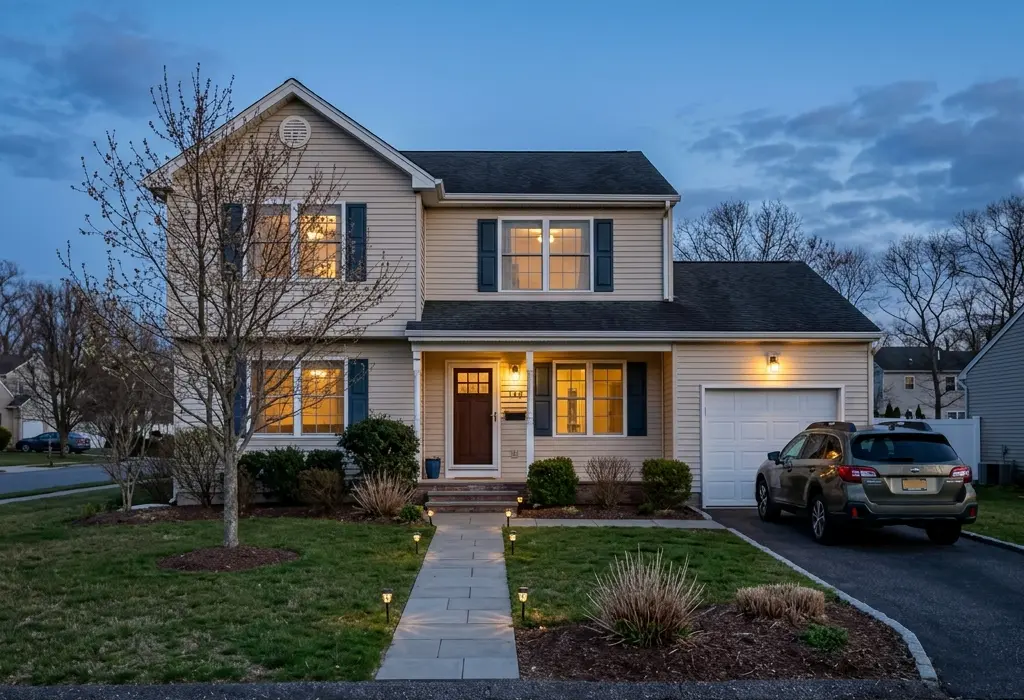
Good outdoor lighting is not about putting the brightest fixture everywhere you can. A better design starts with how you use the property after dark, which areas need visibility, which features you want to highlight, and where unnecessary glare or light spill should be avoided.
For Suffolk County homeowners, outdoor lighting can serve several purposes at the same time: illuminate entrances and walking areas, make patios and decks more useful in the evening, highlight landscaping and architecture, and provide better visibility around the property.
The best result usually comes from planning those purposes together before fixtures and wiring are installed.
Planning new outdoor lighting?
RJ & Son Electric provides
professional outdoor lighting installation
throughout Suffolk County. Call
(631) 833-7663
to discuss your project.
Start With What You Want the Outdoor Lighting to Do
Before choosing fixtures, walk through the property and identify the areas that actually need light.
Outdoor lighting commonly serves four broad purposes:
Visibility
Light walking routes, entrances, steps, changes in elevation, driveways, and other areas people need to navigate after dark.
Outdoor Living
Give patios, decks, cooking areas, seating areas, and other outdoor spaces useful light without making them feel overlit.
Architecture & Landscape
Highlight stonework, trees, plantings, entry features, or other parts of the property that are worth seeing after sunset.
Property Awareness
Improve visibility around entrances, garages, side yards, and other areas where homeowners want to see what is happening after dark.
A fixture should ideally have a reason for being there. That simple rule can help prevent a design from becoming too bright, repetitive, or visually cluttered.
Think in Layers Instead of One Bright Light
Outdoor lighting usually feels more natural when several types of light perform different jobs.
A useful way to think about the design is:
- General lighting for overall visibility around an outdoor space.
- Task lighting where someone is cooking, walking, entering the home, unlocking a door, or completing another activity.
- Accent lighting to draw attention to landscaping, architecture, stone, trees, or other features.
You do not need all three layers in every part of the yard.
A front walkway might need simple route lighting and a well-lit entry. A backyard patio might combine general lighting with focused light near a grill or outdoor kitchen. A landscaped area may only need a small amount of accent lighting.
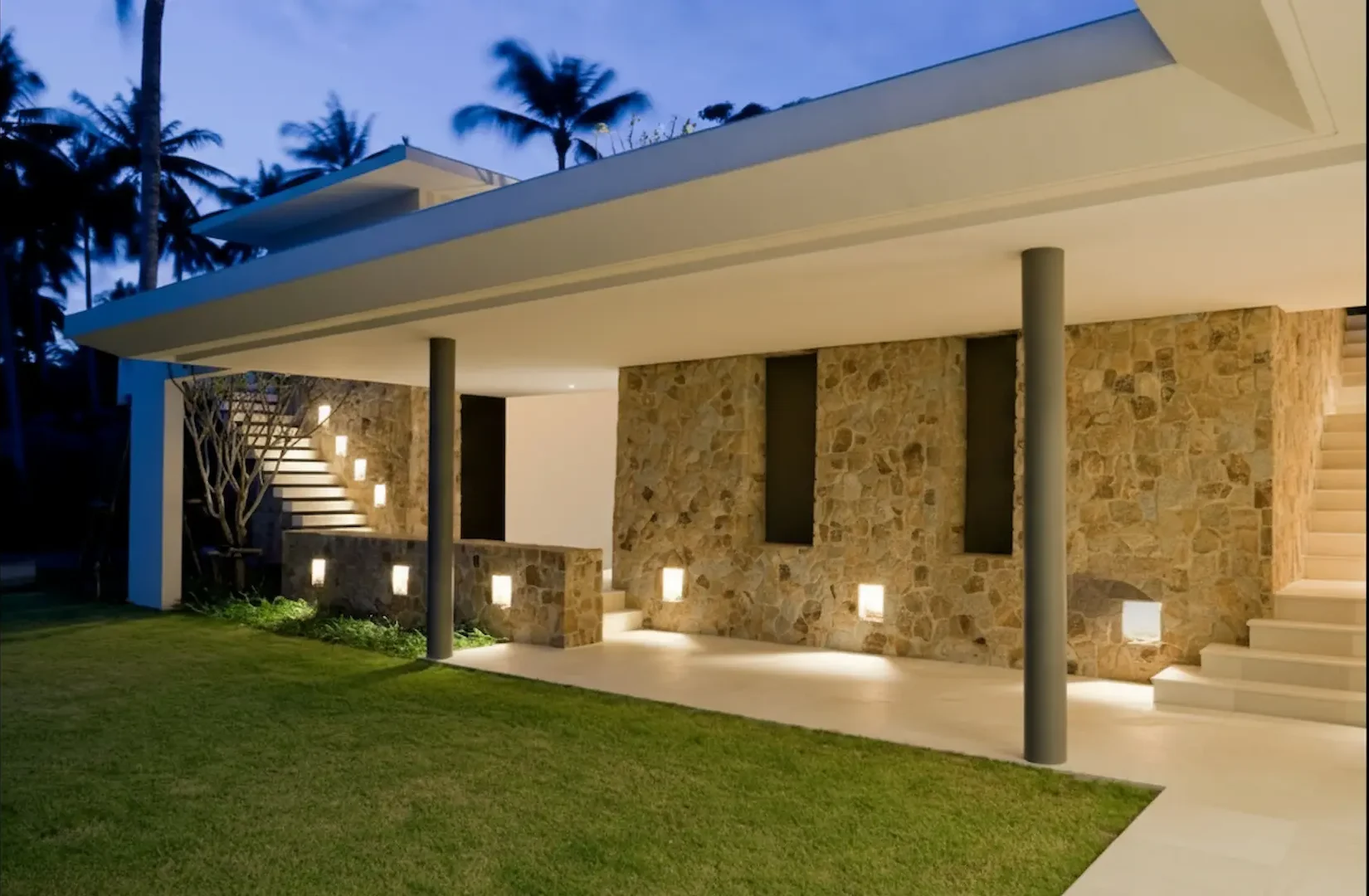
Outdoor lighting can combine practical illumination at steps and walkways with subtle architectural accents.
Common Types of Outdoor Lighting
| Lighting Type | Common Purpose | Design Consideration |
|---|---|---|
| Path lighting | Helps define walkways and landscape edges | Use enough light to make the route visible without creating a row of overly bright fixtures |
| Step lighting | Helps reveal steps and changes in elevation | Aim for useful visibility while limiting direct glare |
| Uplighting | Highlights trees, architectural features, or textured surfaces | Aim and shield fixtures carefully so light stays on the intended feature |
| Downlighting | Provides light from above on entries, patios, walkways, or landscape areas | Placement and aiming affect shadows, glare, and how broad an area is illuminated |
| Wall-mounted lighting | Illuminates entries, garages, porches, patios, and exterior walls | Fixture brightness and distribution should fit the area rather than overpower it |
| Motion-controlled lighting | Provides light when motion is detected | Sensor location, sensitivity, duration, and aiming affect how useful the light is |
| Landscape accent lighting | Highlights plantings, walls, garden features, or other focal points | Use selectively so important features stand out instead of lighting everything equally |
How Far Apart Should Outdoor Lights Be?
There is no universal spacing rule for every outdoor-lighting project.
Fixture spacing depends on:
- The fixture's actual light output and distribution.
- The width and shape of the walkway or driveway.
- Mounting height.
- Landscaping.
- Nearby ambient light.
- Changes in grade.
- The surface being illuminated.
- The visual effect the homeowner wants.
Path lights do not have to create one continuous strip of equal brightness. Sometimes alternating or selective placement produces better visibility and a more natural result.
Likewise, driveway fixtures should be laid out for the actual property rather than installed according to a generic online spacing number.
Pathway Lighting: Light the Route, Not the Whole Yard
Pathway lighting is most useful when it helps people understand where the walking surface goes and where conditions change.
Consider:
- Turns in the walkway.
- Steps.
- Changes in elevation.
- Transitions between pavement and landscaping.
- Entrances.
- Areas where existing architectural light is limited.
More fixtures are not always better. Excessive brightness or direct glare can make a pathway less comfortable to use at night.
Tree and Landscape Uplighting
Uplighting can turn a tree, stone wall, planting, or architectural detail into a nighttime focal point.
The effect depends on the relationship between the fixture and the object being illuminated.
Design factors include:
- The height and shape of the tree or feature.
- The texture being highlighted.
- Where the feature is viewed from.
- The beam produced by the selected fixture.
- Nearby windows or neighboring properties.
- Whether the fixture can be aimed without causing direct glare.
There is no need to assign one beam angle to every tree. A narrow trunk, broad canopy, stone wall, and low landscape feature can all require different fixture choices and placement.
What Is Moonlighting?
Moonlighting is a design technique that uses light from an elevated position to create a softer downward effect across landscaping or an outdoor area.
Depending on the property, a downlighting effect may also be created from the house, an architectural feature, or another appropriate mounting location.
The important design considerations are:
- Safe fixture installation.
- Access for future maintenance.
- Glare.
- Shadow patterns.
- The area that actually needs illumination.
Mounting electrical equipment high in a tree is not something every homeowner needs or every property supports, so the design should fit the site rather than forcing a particular effect.
Outdoor Lighting for Steps and Changes in Elevation
Steps, retaining walls, decks, and transitions between levels are useful places to think about low-glare lighting.
Possible approaches can include:
- Integrated step lights.
- Wall-mounted fixtures.
- Under-rail lighting.
- Nearby downlighting.
- Path fixtures positioned to reveal the change in elevation.
The goal is not to make the steps as bright as possible. It is to make the shape, edges, and direction of travel easier to see without placing a glaring fixture directly in someone's line of sight.
How to Plan Outdoor Lighting Around a Patio or Deck
Patios and decks often need more than one type of light because people use them for several activities.
Think about where people:
- Enter and leave the house.
- Walk between levels.
- Cook or prepare food.
- Eat.
- Sit and talk.
- Move around furniture.
A useful design might combine softer general lighting with more focused illumination where a task actually requires it.
Separate controls can also be useful because the amount of light wanted while cooking may be very different from the amount wanted while sitting outside later in the evening.
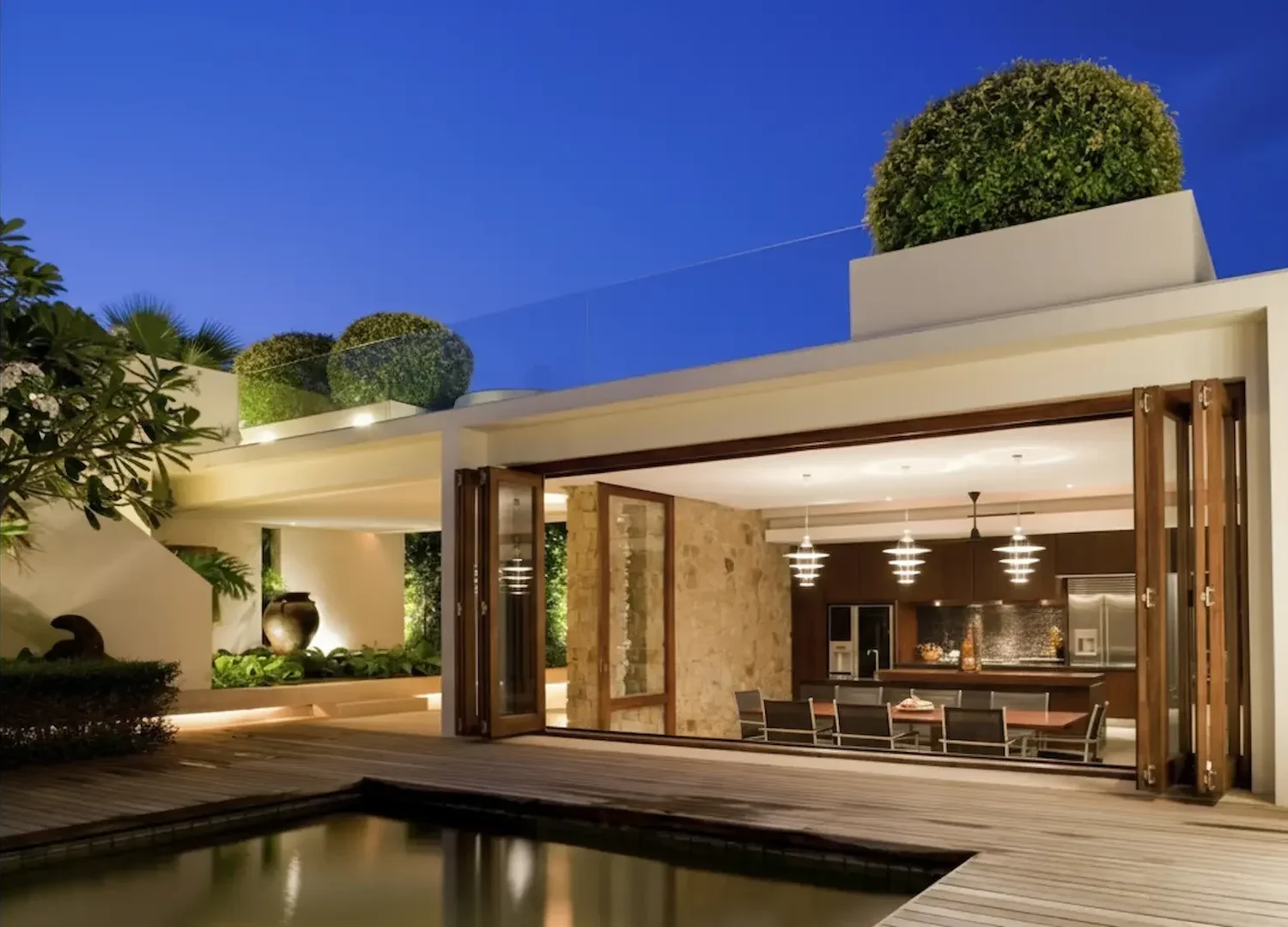
Outdoor living areas can use different lighting layers for entries, cooking, seating, walking areas, and architectural accents.
Outdoor Kitchen and Grill Lighting
Outdoor cooking areas benefit from light where food is prepared and equipment is used.
That can be different from the softer lighting used around a nearby dining or seating area.
When planning the electrical work, consider:
- Where the cooking and preparation surfaces are located.
- Where switches or controls will be convenient.
- Whether other electrical equipment is part of the outdoor kitchen.
- Exposure to weather.
- How fixtures will be serviced later.
Lighting should be coordinated with the overall electrical plan rather than treated as an afterthought once outdoor cabinets, appliances, or hardscape are already installed.
Front Entry Lighting
Front entry lighting usually needs to accomplish several simple things:
- Make the door and entry area visible.
- Help guests identify where to walk.
- Provide useful light for keys, packages, or door hardware.
- Complement the scale and architecture of the home.
Extremely bright porch or garage fixtures can create glare and make surrounding areas look darker by comparison.
A balanced entry often works better than trying to illuminate the entire front yard from one powerful fixture.
Driveway and Garage Lighting
Driveway lighting can help define the route to the garage, reveal changes in grade, and improve visibility near parking and walking areas.
Fixture choice depends on the property.
Possible sources include:
- Garage-mounted lighting.
- Wall-mounted fixtures.
- Landscape fixtures.
- Low bollard-style lighting where appropriate.
- Motion-controlled fixtures.
- Lighting integrated into other site features.
Long, narrow, curved, steep, and short driveways do not need the same layout, so fixed spacing rules are not particularly useful.
Can Outdoor Lighting Improve Security?
Outdoor lighting can improve visibility around a property. That can help homeowners see entrances, walkways, garages, side yards, and activity outside after dark.
But lighting should not be sold as a guarantee that crime or trespassing will be prevented.
A useful security-oriented lighting plan can consider:
- Entrances.
- Garage doors.
- Side-yard access.
- Walking routes.
- Areas viewed from inside the home.
- Motion-controlled locations.
More light is not automatically more useful. Excessive glare can make it harder to see detail and can spill into neighboring properties.
Motion-Sensor Lighting: Where It Helps
Motion controls can be useful where homeowners want light available when someone approaches without leaving the fixture at full output all night.
Common applications include:
- Garages.
- Side yards.
- Back entrances.
- Driveways.
- Utility or storage areas.
Sensor placement matters. Vegetation, traffic, animals, weather, and the direction people normally approach can affect how a motion sensor performs.
Controls should be selected and adjusted for the actual location rather than relying on a one-size-fits-all sensitivity setting.
Use Light Where It Is Needed
Responsible outdoor lighting does not mean eliminating exterior light. It means making the light useful.
DarkSky International organizes responsible outdoor lighting around five practical ideas:
- Use light only where it serves a purpose.
- Direct the light toward the area that needs it.
- Use no more brightness than necessary.
- Use controls so light operates when needed.
- Favor warmer light where practical.
Review the Five Principles for Responsible Outdoor Lighting .
Those principles work well for residential design because they encourage useful visibility while reducing glare, spill, and unnecessary nighttime lighting.
Why Glare Matters
A bright fixture can produce plenty of light and still be uncomfortable or poorly placed.
Direct glare happens when the bright source itself is prominent in someone's view. This can occur with:
- Flood lights aimed too horizontally.
- Exposed landscape uplights.
- Fixtures that are too bright for their mounting height.
- Wall lights with uncontrolled output.
- Path fixtures that shine directly toward the eye.
Shielding, fixture selection, aiming, mounting height, and brightness all affect glare.
A successful design puts the emphasis on the area being illuminated rather than the light source itself.
Warm vs. Cool Outdoor Light
Color temperature changes the visual character of a property at night.
Warmer light often works well with residential architecture, wood, brick, stone, landscaping, and outdoor seating areas. Cooler light can appear brighter or more clinical depending on the fixture and surrounding materials.
There is no reason every outdoor fixture on every Suffolk County property must use one exact color temperature.
Instead, consider:
- The architecture.
- Existing exterior fixtures.
- Landscape materials.
- The purpose of the light.
- How nearby fixtures will look together.
Consistency between adjacent fixtures often matters more visually than chasing one universal number.
How Bright Should Outdoor Lighting Be?
Brightness should follow the job the fixture needs to perform.
A small landscape accent does not need the same output as a driveway fixture. A porch light does not need the same output as a large commercial parking-area light.
Fixture selection should consider:
- The area being illuminated.
- Mounting height.
- Beam distribution.
- Surface reflectance.
- Nearby lighting.
- Glare.
- Whether dimming or other control will be used.
More lumens do not automatically create a better design.
Outdoor Lighting Near Neighbors
Light does not always stop at the property line.
Before installing a fixture near the side or rear of a property, consider whether it will shine:
- Into a neighboring window.
- Across an adjacent yard.
- Toward a nearby roadway.
- Into the eyes of someone using the property.
Shielded fixtures and careful aiming can often provide useful light on your property without sending unnecessary light elsewhere.
Outdoor Lighting for Suffolk County Properties
Suffolk County includes a wide range of residential settings, from smaller suburban lots to larger wooded properties and homes close to Long Island's shoreline.
The installation environment matters when choosing outdoor electrical equipment.
Depending on the property, consider:
- Direct rain or snow exposure.
- Sprinklers and irrigation.
- Soil and drainage conditions.
- Landscape maintenance.
- Tree roots and planting areas.
- Salt exposure on properties close to the shoreline.
- Freeze and thaw conditions.
- Where wiring and equipment can be protected from physical damage.
A Suffolk County address does not automatically mean every fixture needs a marine-grade finish. Homes with direct coastal exposure can have different material considerations from properties farther inland. Fixture selection should match the actual installation environment.
Choose Fixtures for the Actual Outdoor Location
Outdoor fixtures should be selected for the conditions where they will be installed.
A fixture under a protected porch can experience a different environment from a fixture:
- Mounted on an exposed wall.
- Installed in a landscape bed.
- Located near irrigation.
- Installed on a deck or patio.
- Placed close to coastal salt exposure.
Product labeling and manufacturer installation instructions should be considered when selecting equipment for damp, wet, exposed, or other outdoor locations.
Homeowners do not need to choose fixtures based solely on a generic IP-rating chart copied from the internet.
Low-Voltage Landscape Lighting vs. Line-Voltage Lighting
Outdoor lighting systems can use different electrical approaches depending on the project.
| System Type | Common Applications | Planning Considerations |
|---|---|---|
| Low-voltage landscape lighting | Path lights, landscape accents, garden lighting, some step and architectural applications | Transformer location, total system load, wire routing, distance, fixture placement, and future expansion |
| Line-voltage outdoor lighting | Wall fixtures, flood lights, garage lights, some post lights, architectural lighting, and other fixed installations | Electrical circuits, controls, wiring methods, fixture location, weather exposure, and project requirements |
One system is not automatically better for every project.
Low-voltage lighting can work very well for landscape applications, while line-voltage fixtures may make sense for building-mounted lighting and other installations.
Transformer Planning for Low-Voltage Lighting
Low-voltage landscape lighting often uses a transformer to supply the lighting system.
Transformer selection should account for the actual connected lighting load, wiring layout, system design, and equipment being used.
The project should also consider:
- Where the transformer will be mounted.
- Access for future service.
- How circuits or zones will be controlled.
- Long wiring runs.
- Future fixture additions if they are part of the plan.
Homeowners do not need to perform their own transformer or voltage-drop calculations before calling an electrician. Those are part of planning the actual system.
LED Outdoor Lighting and Energy Use
LED technology is well suited to outdoor lighting because efficient light sources can provide useful illumination with less electricity than older, less-efficient technologies.
The U.S. Department of Energy also notes that exterior-lighting controls can create additional energy savings by reducing light output or turning lighting off when it is not needed.
Review Department of Energy exterior-lighting guidance .
The actual savings for a homeowner depend on:
- The lighting being replaced.
- The new fixtures or lamps.
- Fixture quantity.
- Operating hours.
- Light output.
- Controls.
- Electricity rates.
There is no reason to promise one fixed percentage of savings or one universal payback period for every outdoor-lighting project.
Do LED Fixtures Always Last 50,000 Hours?
No single lifespan applies to every LED product and installation.
LED performance and service life can depend on:
- Product design and quality.
- Operating temperature.
- Driver and electronic components.
- Operating hours.
- Weather exposure.
- Installation conditions.
LEDs can offer long service life, but a homeowner should use the specifications and warranty information for the actual product being considered rather than a generic website lifespan.
Timers, Photocells and Motion Controls
Lighting controls can reduce unnecessary operating time and make an outdoor system easier to use.
Depending on the project, options can include:
- Timers.
- Photocells or dusk-to-dawn control.
- Motion sensors.
- Dimmers where compatible.
- Separate zones.
- Smart switches or compatible lighting controls.
The Department of Energy specifically notes that exterior lighting can use controls to reduce energy use when full lighting is not needed. :contentReference[oaicite:5]{index=5}
Controls should be chosen around how the homeowner actually uses the property rather than adding technology simply because it is available.
Do You Need Wi-Fi, Zigbee or Z-Wave for Outdoor Lighting?
No.
Smart-home integration is optional.
A homeowner may want app control, schedules, scenes, or integration with an existing smart-home platform, but a well-designed outdoor lighting system does not require a particular wireless protocol.
If smart controls are desired, it is more useful to consider:
- Compatibility with the fixtures and electrical controls.
- How the homeowner already controls other devices.
- Signal or network availability where needed.
- Whether manual control will still be convenient.
- What happens if the internet connection is unavailable.
The control system should serve the lighting design, not make the lighting unnecessarily complicated.
Can Outdoor Lighting Increase Property Value?
Attractive outdoor lighting can improve the appearance and usability of a property, but no specific increase in home value should be promised.
Resale value depends on many factors, including the property, neighborhood, broader market, quality of the work, and the preferences of future buyers.
The strongest reasons to install outdoor lighting are the reasons homeowners can actually evaluate: visibility, appearance, evening use, and how well the system serves the property.
Planning Wiring Before Landscaping or Hardscape Is Finished
If a larger landscape, patio, pool-area, driveway, or outdoor-kitchen project is being planned, electrical work is easier to coordinate before every surface is finished.
Early planning can help identify:
- Fixture locations.
- Switch and control locations.
- Transformer locations.
- Wiring routes.
- Future lighting zones.
- Areas where hardscape or landscaping may affect access.
That does not mean every outdoor project requires extensive new wiring. It means electrical planning should happen early enough that the lighting system does not conflict with other parts of the project.
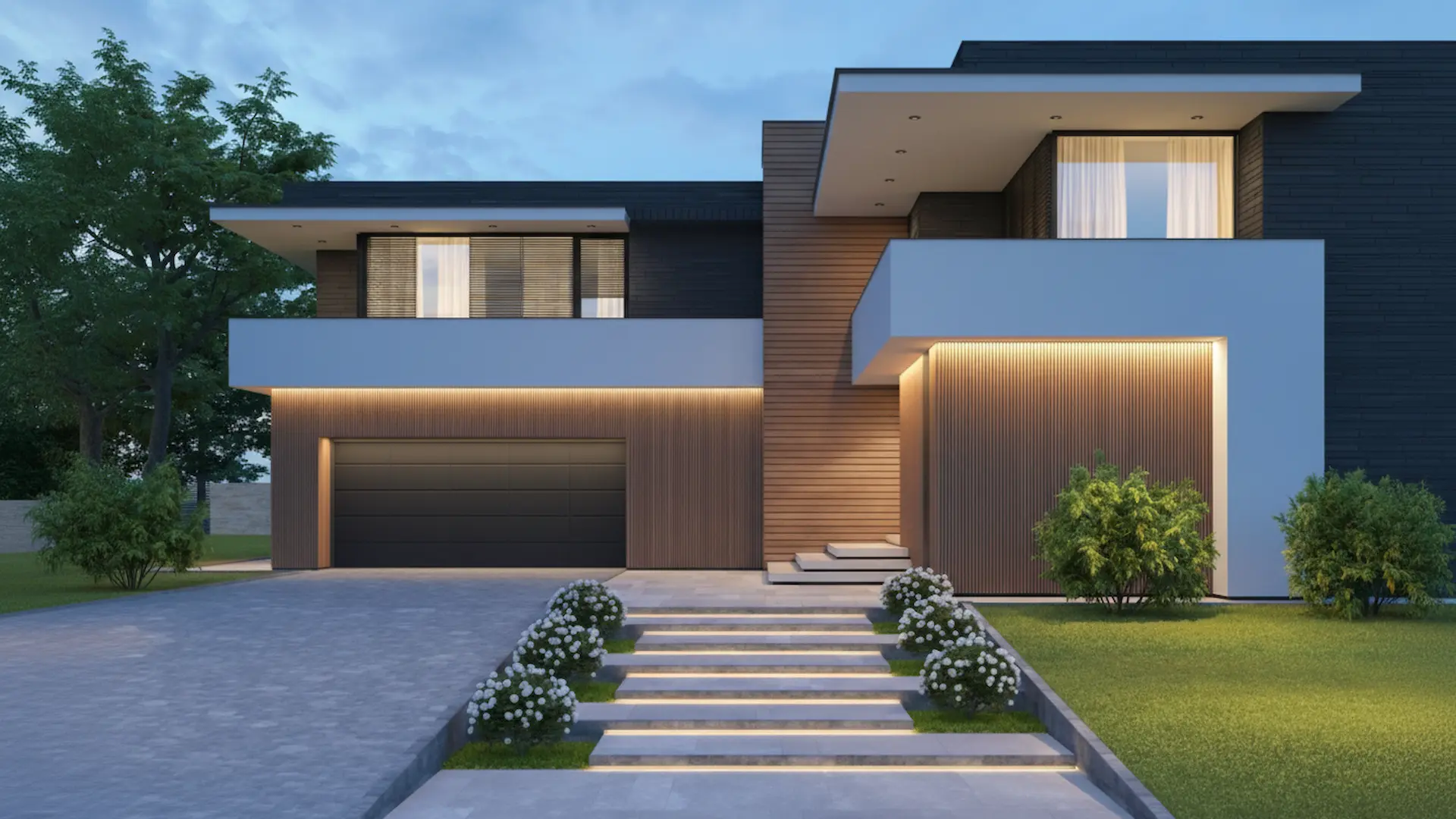
Coordinating fixture locations, wiring, controls, architecture, and landscaping before installation can create a cleaner final lighting plan.
Outdoor Lighting Around Pools and Water Features
Electrical work around pools, spas, fountains, and other water features deserves project-specific planning because water and electricity require careful separation and appropriate equipment.
If lighting is being added near a pool or water feature, discuss the project with a licensed electrician rather than relying on general online spacing or wiring advice.
The electrical requirements depend on the actual location, equipment, wiring, and scope of work.
Does Every Outdoor Lighting Project Need a Permit?
No single answer applies to every outdoor-lighting project.
Requirements can depend on:
- The municipality.
- The electrical work being performed.
- Whether new fixed wiring is being installed.
- Whether the work is part of a larger construction or renovation project.
- Other project-specific conditions.
Fixture replacement can be very different from adding new circuits, trenching, new exterior electrical equipment, or electrical work connected to a larger renovation.
Permit and inspection requirements should be confirmed for the actual project.
Does Every Outdoor Lighting Project Need a Load Calculation?
Not every lighting project requires the same electrical evaluation.
The amount of electrical planning depends on the size and type of system being installed, the existing electrical system, and whether new circuits or other substantial loads are involved.
A small lighting change is different from a large exterior project involving several new circuits, transformers, controls, outdoor kitchens, pumps, heaters, or other electrical equipment.
Should Homeowners Install Outdoor Electrical Wiring Themselves?
Homeowners can absolutely participate in the design by deciding what they want illuminated, choosing fixture styles, and identifying how they use the property.
Fixed outdoor electrical work is different.
Professional installation is particularly appropriate when a project involves:
- New fixed wiring.
- New circuits.
- Exterior electrical boxes.
- Buried wiring routes.
- Outdoor line-voltage fixtures.
- Transformers and larger low-voltage systems.
- Work around pools or water features.
- Changes to existing electrical equipment.
RJ & Son Electric provides outdoor lighting installation for Suffolk County homeowners.
What If an Existing Outdoor Light Keeps Tripping or Stops Working?
An outdoor-lighting failure does not automatically mean the fixture itself is bad.
Depending on the system, possible areas to evaluate can include:
- The fixture.
- The lamp or LED components.
- A switch or control.
- A photocell or motion sensor.
- Electrical connections.
- Wiring.
- A transformer.
- The circuit or protective device.
- Water or physical damage.
RJ & Son Electric also provides electrical troubleshooting and repair when an existing lighting system develops an electrical problem.
What If an Outdoor Fixture Is Sparking, Smoking or Smells Burnt?
Keep away from electrical equipment that is visibly sparking, smoking, badly damaged, unusually hot, or producing a persistent burning odor.
Do not remove the fixture or open electrical equipment in an attempt to investigate live wiring.
Active Fire, Heavy Smoke or Serious Electrical Injury?
Leave the affected area and call 911. For an urgent property-specific electrical problem without an immediate life-safety emergency, RJ & Son Electric provides 24/7 emergency electrical service throughout Suffolk County.
Visit the 24/7 emergency electrician page or call (631) 833-7663 for current availability.
How Much Does Outdoor Lighting Installation Cost?
There is no useful single price for an outdoor-lighting project because the scope can vary from adding one exterior fixture to designing lighting throughout an entire property.
Cost can depend on:
- Number and type of fixtures.
- Existing wiring.
- Whether new circuits are required.
- Low-voltage vs. line-voltage equipment.
- Transformer requirements.
- Wiring distance.
- Landscape or hardscape access.
- Controls.
- Fixture quality and specifications.
- Mounting conditions.
- Other electrical work included in the project.
A quote should be based on the actual design and installation scope rather than multiplying a generic per-fixture internet price.
A Simple Outdoor Lighting Planning Process
Why Choose RJ & Son Electric for Outdoor Lighting?
RJ & Son Electric provides indoor and outdoor lighting installation throughout Suffolk County, including landscape and pathway lighting, porch and patio lighting, garage and driveway lighting, flood lights, motion-sensor lighting, and smart lighting controls.
Richard-Led Service
Richard Gruttola is the Master Electrician behind RJ & Son Electric and is directly involved in the electrical work and customer communication.
Licensed & Insured
RJ & Son Electric is licensed and insured. Richard holds Master Electrician License ME-72156.
Indoor & Outdoor Lighting
Lighting services include landscape, pathway, porch, patio, driveway, garage, motion-sensor, recessed, LED, and other lighting installations.
Electrical Troubleshooting
Existing lighting problems can be diagnosed before a fixture, switch, transformer, wiring, or other electrical component is automatically replaced.
Frequently Asked Questions About Outdoor Lighting Design
How far apart should outdoor pathway lights be?
There is no universal spacing that fits every property. Fixture output, beam distribution, walkway width, landscaping, mounting height, existing light, changes in grade, and the desired visual effect all influence placement.
What types of outdoor lighting work well around a home?
Common options include pathway lights, step lights, uplights, downlights, wall-mounted fixtures, landscape accent lights, porch and patio lighting, driveway lighting, flood lights, and motion-controlled fixtures. The right mix depends on how the property is used after dark.
Does brighter outdoor lighting provide better security?
Not necessarily. Lighting can improve visibility around a property, but excessive brightness and glare can make it harder to see detail and can create unwanted light spill. Lighting also cannot guarantee that crime or trespassing will be prevented.
Should every Suffolk County home use marine-grade outdoor fixtures?
No. Fixture materials should match the actual installation environment. Properties with direct coastal salt exposure may have different corrosion concerns from homes farther inland, while rain, irrigation, soil, mounting location, and other exposure conditions also matter.
Is low-voltage landscape lighting better than line-voltage lighting?
Neither system is automatically better for every project. Low-voltage systems are commonly useful for landscape and pathway applications, while line-voltage fixtures may be appropriate for wall-mounted lighting, flood lights, garage lighting, and other installations. The design should fit the property and intended use.
Do LED outdoor lights use less electricity?
Efficient LED lighting can use less electricity than older, less-efficient lighting technologies for comparable applications. Actual savings depend on the products being replaced, new fixtures, operating hours, light levels, controls, fixture quantity, and electricity rates.
Do LED outdoor fixtures always last 50,000 hours?
No single service-life number applies to every product. LED life depends on the product design, electronic components, temperature, operating hours, weather exposure, and installation conditions. Review the specifications for the actual fixture being considered.
Can timers and motion sensors save energy?
Controls can reduce unnecessary operating time by turning lights off, dimming them, or activating them only when needed. The best control strategy depends on how the homeowner uses the property and which areas need light.
Does every outdoor lighting installation need a permit?
No single requirement applies to every project. Permit and inspection requirements depend on the municipality and scope of work. Fixture replacement can be different from new circuits, buried wiring, trenching, or lighting installed as part of a larger construction project.
Does RJ & Son Electric install outdoor lighting?
Yes. RJ & Son Electric provides outdoor lighting installation throughout Suffolk County, including landscape and pathway lighting, porch and patio lighting, garage and driveway lighting, flood lights, motion-sensor lighting, and related electrical work.
Related Lighting Resources
Lighting Installation
Indoor and outdoor lighting installation for homes and businesses throughout Suffolk County.
Electrical Repairs
Troubleshooting for outdoor lights, switches, circuits, wiring, controls, and other electrical problems.
Commercial Lighting Upgrades
A separate guide for businesses considering LED lighting upgrades, controls, and commercial lighting improvements.
Suffolk County Service Areas
See the communities where RJ & Son Electric provides lighting and other electrical services.
Planning Outdoor Lighting in Suffolk County?
RJ & Son Electric installs landscape, pathway, porch, patio, driveway, garage, motion-sensor, flood, accent, and other outdoor lighting for Suffolk County properties. Richard Gruttola is a licensed and insured Master Electrician who can help turn the lighting plan into a clean electrical installation.
Licensed & Insured Master Electrician serving Suffolk County, NY
Master Electrician License ME-72156
(631) 833-7663 · RichG@rjandsonelectric.com