Why Choose Local Electrical Repair Services from RJ & Son Electric in Suffolk County
Electrical issues at home or work demand quick, safe answers — from a tripped breaker that ruins your morning to faulty wiring that creates a fire risk. Hiring a nearby electrician shortens response time, taps local code know‑how, and reduces repeat visits by addressing the issues we see most in this area. This guide explains why local electrical repair services in Suffolk County typically deliver faster, safer, and more cost‑effective results. You’ll learn the main benefits of hiring a local pro, how a licensed Master Electrician protects your home and business, which repairs are best handled locally, and why clear pricing matters. We also cover community advantages, code compliance priorities, and what to expect during diagnostics and quoting so you can make confident decisions about electrical troubleshooting and repairs.
What Are the Key Benefits of Hiring a Local Electrician in Suffolk County?
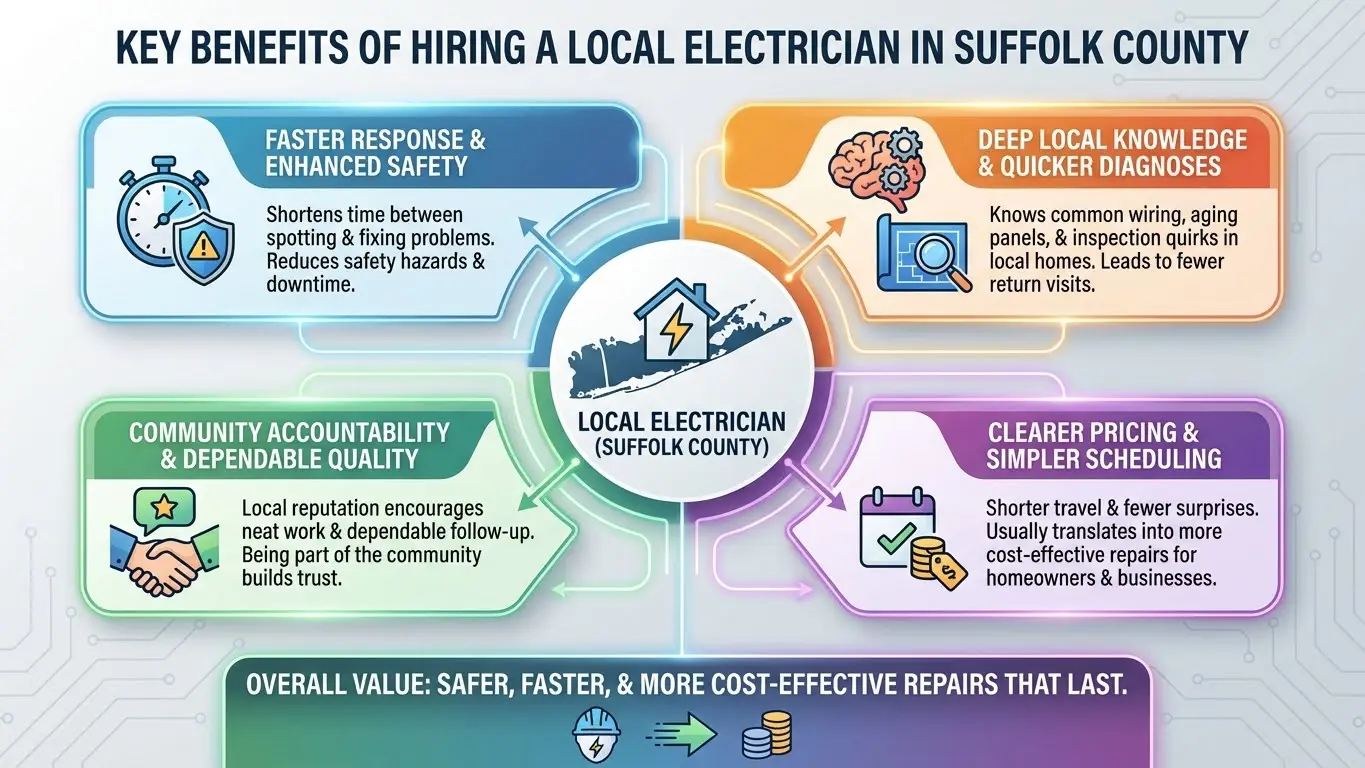
Local electricians shorten the time between spotting a problem and fixing it, which reduces safety hazards and downtime. Technicians who work in the same towns know the common wiring layouts, aging panels, and inspection quirks in Suffolk County homes — that means quicker diagnoses and fewer return visits. Being part of the community also creates accountability: local reputation encourages neat work and dependable follow‑up. Finally, shorter travel and simpler scheduling usually translate into clearer pricing and fewer surprises. Together, these factors make repairs safer, faster, and more cost‑effective for both homeowners and businesses.
On top of speed, local knowledge improves repair quality by letting technicians spot recurring faults and target fixes that last.
Understanding the Role and Safety Standards of Electrical Contractors
Electrical wiring and cabling are central to safe installations. Systems must be installed, altered, or extended in ways that protect people and property. The Code establishes minimum safety expectations for electrical work in buildings and related structures, though it does not cover specialized installations in ships, aircraft, or vehicles. Detailed design for complex electrical systems requires professional engineering beyond these general provisions. In short: licensed contractors follow the Code to keep installations reasonably safe for occupants and inspectors.
Understanding the Role of Electrical Contractors
Here are the main advantages local electricians bring to Suffolk County residents and businesses:
- Faster on‑site response to reduce immediate safety risks and business interruptions.
- Familiarity with local wiring, panel types, and inspection practices for quicker, more accurate diagnoses.
- Community reputation that encourages accountability, tidy work, and dependable follow‑up.
- Lower travel and coordination overhead, which often means clearer pricing and fewer surprises.
The bottom line: hiring local improves safety, compliance, and convenience. If you need fast help in Suffolk County towns like Selden, Setauket, Smithtown, or The Hamptons, consider contacting a licensed local provider for quick dispatch and repairs done to local code.
RJ & Son Electric is a licensed, insured Master Electrician service serving Suffolk County and nearby towns. For emergencies or to request rapid diagnostics, call us at (631) 833-7663 or email [email protected]. Our local dispatch model focuses on fast response, knowledge of regional inspection processes, and clear communication to reduce risk and restore safe electrical function quickly.
How Does Local Knowledge Improve Electrical Repair Quality?
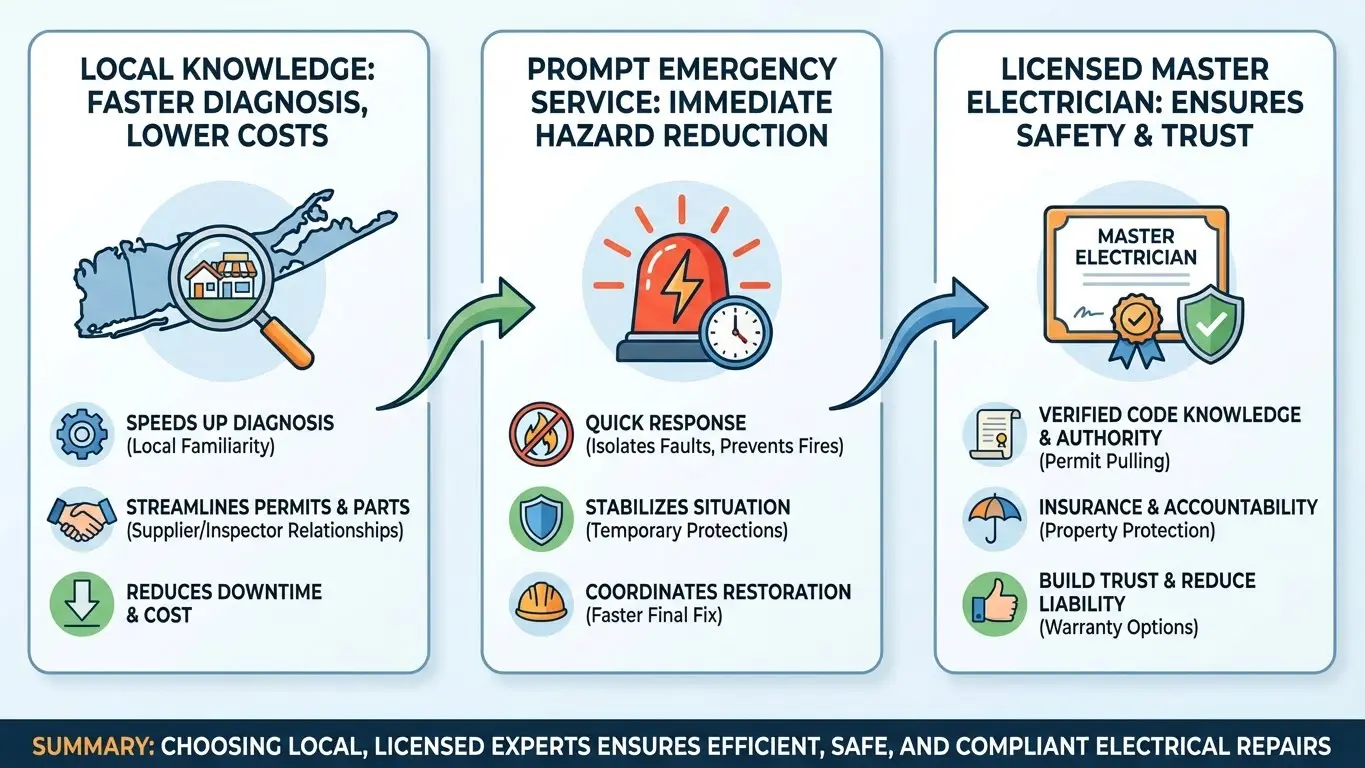
Local familiarity speeds up diagnosis by matching symptoms to the causes we commonly see in Suffolk County homes and businesses. Electricians who know local building ages and typical panel brands can skip generic checks and head straight to likely problem areas, cutting down guesswork and parts delays. That same familiarity helps with permits because local techs understand what inspectors expect and what corrections are most common. Faster, permit‑ready repairs mean less secondary damage, fewer follow‑up visits, and lower overall costs.
Working relationships with nearby suppliers and inspection offices also streamline ordering and scheduling, which reduces downtime and makes project timelines more predictable.
Why Is Prompt Emergency Electrical Service Crucial for Local Repairs?
Quick emergency response reduces immediate hazards — live faults, overheating panels, or persistent arcing can lead to fires or shocks if left alone. A nearby crew can stabilize the situation right away: isolate circuits, add temporary protections, and recommend safe next steps to limit damage and risk. Local electricians also coordinate faster with inspectors and other trades when permits or follow‑up work are needed, shortening the time from emergency fix to final, code‑compliant restoration. Early intervention limits secondary failures and often lowers repair scope and cost.
Knowing the emergency workflow — isolation, temporary stabilization, full diagnostic, and permit coordination — helps homeowners and business owners act quickly and confidently when it matters most.
How Does Choosing a Licensed Master Electrician Ensure Safety and Trust?
A licensed Master Electrician has formal credentials that lead to better safety outcomes, verified code knowledge, and the authority to pull permits for complex jobs. Licensing represents a baseline of training and oversight; insurance protects property owners if accidental damage occurs. Those credentials give you warranty options and accountability that unlicensed providers usually can’t offer. License, insurance, and documented workmanship build trust and reduce the chance of unsafe or non‑compliant installations.
Below is a simple comparison to help you weigh safety and trust when choosing a local contractor.
| Electrician Type | Credential / Coverage | Impact on Safety and Outcome |
|---|---|---|
| Licensed Master Electrician | State license, insurance, permit authority | Better assurance of code compliance, legal permitting, and accountability |
| Journeyman / Licensed Technician | Professional training, often works under a master | Skilled for many tasks but may need supervision for permit work |
| Unlicensed Provider | No formal license or insurance | Greater risk of non‑compliance, safety gaps, and limited recourse |
This comparison shows that licensed Master Electricians offer stronger legal protection, consistent standards, and smoother inspection outcomes. Choosing a licensed pro reduces liability and increases the chance of a safe, compliant repair.
What Makes a Master Electrician Different from Other Electricians?
A Master Electrician holds the top level of trade licensure and can design, supervise, and sign off on complex installations and major repairs. This credential reflects advanced training, code knowledge confirmed by testing, and the ability to pull permits and deal with inspectors on your behalf. For jobs like panel upgrades, whole‑house rewiring, or any work that affects service capacity and long‑term safety, a Master Electrician is the right choice. Their oversight reduces legal and safety exposure by ensuring installations meet local codes.
For projects involving inspectors, higher amperage, or grounding changes, hiring a Master Electrician lowers risk and helps avoid costly rework.
How Does Transparent Pricing Build Customer Confidence?
Transparent pricing starts with a clear diagnostic that identifies the root cause and scopes the job before quoting. You should receive an itemized written quote that breaks out labor, parts, permit fees, and timelines. That clarity prevents surprises and lets you compare repair versus replacement on real terms. If work changes mid‑job, approved change orders and written consent keep everyone aligned. Clear communication about warranties and follow‑up service further strengthens confidence in both immediate repairs and long‑term performance.
A basic checklist customers should expect: initial inspection, itemized written quote, customer approval, and documented post‑job verification. Those steps reduce ambiguity and form the backbone of an honest contractor relationship.
What Types of Electrical Repairs and Troubleshooting Are Best Handled Locally?
Local electricians are ideal for urgent residential and light‑commercial troubleshooting — problems that need fast diagnosis and a knowledge of local installation patterns. Common local repairs include faulty breakers, dead outlets, flickering lights, and the detection of burning smells that point to dangerous wiring conditions.
More complex work that still benefits from local handling includes panel upgrades, rewiring older homes, EV charger installation, and generator transfer switch work where permit coordination and inspection scheduling matter. Local teams also handle follow‑up inspections and corrective work faster than out‑of‑area contractors.
Use this quick guide to decide when to call a pro and when a safe homeowner check is enough.
- Tripped breakers and overloaded circuits: you can try moving devices off the circuit briefly, but recurring trips need a licensed electrician.
- Non‑working outlets and GFCI failures: resetting is a safe first step; repeated failures suggest wiring problems or shared‑circuit issues.
- Flickering lights and burning odors: stop using affected circuits and call a professional immediately — these are warning signs.
Short‑term resets are fine, but persistent or dangerous symptoms require a licensed local technician. RJ & Son Electric lists Electrical Repairs & Troubleshooting among our core services and can provide fast diagnostics and safe repairs across Suffolk County.
How Are Common Electrical Issues Like Tripped Breakers and Flickering Lights Diagnosed and Fixed?
Diagnosis starts with safe, observable checks: see if breakers reset, identify which circuits are affected, and look for overloaded appliances or power strips. A licensed electrician follows up with circuit tracing, thermal scans of panels, and continuity testing to find loose neutrals, failing breakers, or overloaded lines. Fixes range from tightening connections and replacing bad breakers to rerouting loads or upgrading branch circuits when capacity is exceeded. The aim is to eliminate the symptom and fix the underlying cause so the problem doesn’t come back and the work meets safety codes.
If a diagnostic shows burning, corrosion, or shared neutrals, the immediate step is circuit isolation and a code‑compliant repair plan to reduce fire and shock risk.
Why Is Local Expertise Important for Complex Repairs Like Panel Upgrades and Wiring?
Panel upgrades and rewiring need permits, inspection coordination, and parts that meet local code interpretations. Local electricians know common service limits in Suffolk County homes, the panel models that tend to fail, and the documentation inspectors expect for approval. Those relationships with suppliers and inspectors speed scheduling and lower the chance of rework. Well‑scoped upgrades also include load calculations and future‑proofing for EV chargers or generator transfer switches, plus grounding improvements for long‑term reliability.
Planning with local inspection expectations in mind reduces delays and results in safe, durable electrical systems that meet community standards.
How Does Supporting a Local Electrician Benefit the Suffolk County Community?
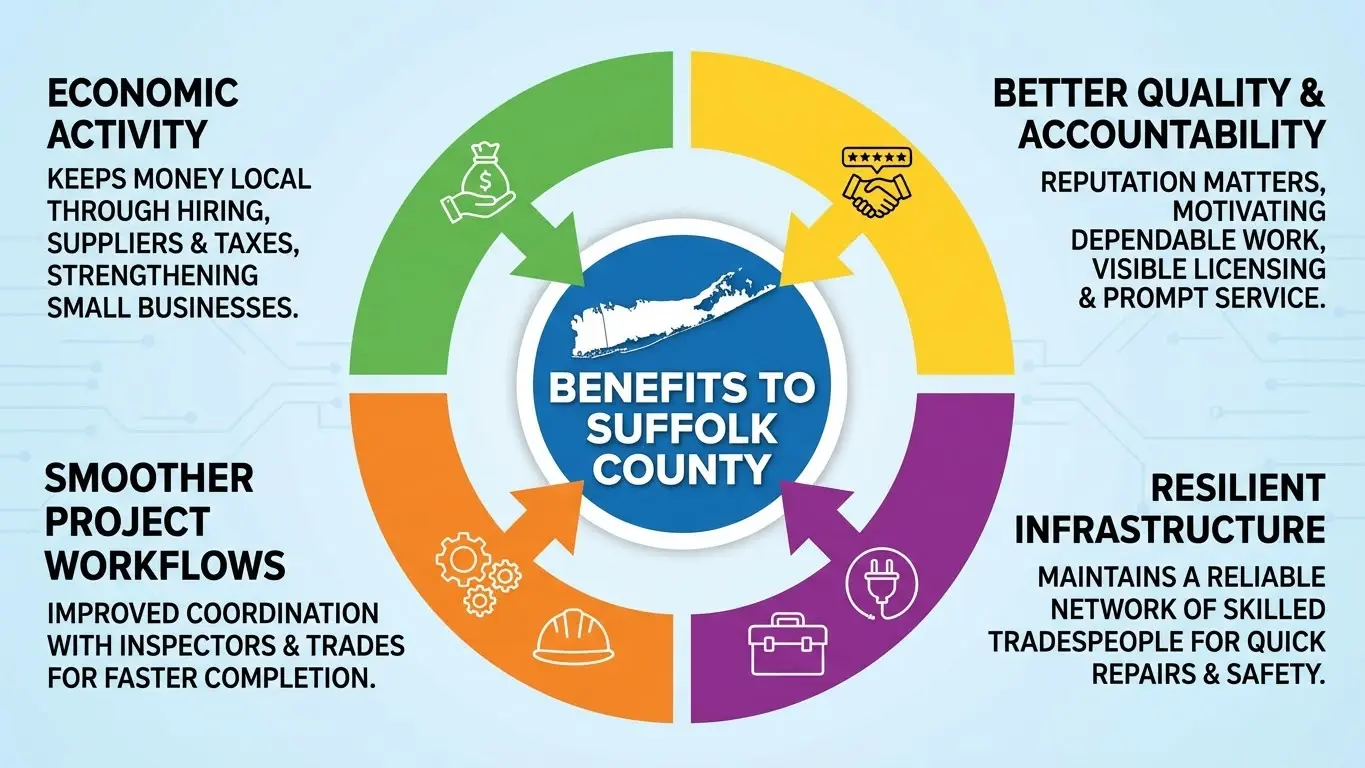
Hiring local electrical contractors keeps money in the community through local hiring, supplier purchases, and tax contributions, which strengthens small businesses. Local firms invest in their reputations, leading to dependable work, visible licensing, and prompt warranty service. Partnerships between electricians, inspectors, and suppliers also smooth project workflows and speed resolution of code questions. These community benefits help keep infrastructure resilient by ensuring routine repairs and upgrades get done quickly and correctly.
Choosing local providers also increases accountability — in tight‑knit communities, reputation matters and that motivates higher service standards.
- Keeps economic activity in Suffolk County through local hiring and supplier use.
- Encourages better service quality thanks to visible reputation and local reviews.
- Improves coordination with inspectors and other trades for faster project completion.
Prioritizing local contractors helps maintain a reliable network of skilled tradespeople who respond quickly and uphold safety standards.
What Role Does RJ & Son Electric Play in Supporting Local Residents and Businesses?
RJ & Son Electric is a licensed, insured Master Electrician service serving Suffolk County communities like Selden, Setauket, Smithtown, and The Hamptons. We focus on electrical repairs and troubleshooting, fast diagnostics, and safe repairs for hazards such as tripped breakers, dead outlets, flickering lights, and burning smells. With local dispatch and knowledge of regional permitting, we aim to speed inspections and provide dependable follow‑up service. Our presence in the community helps circulate local economic value and gives residents a trusted resource for both routine maintenance and emergency response.
If you want a local partner who understands code requirements and communicates clearly, RJ & Son Electric is available to help resolve electrical risks efficiently.
How Does Hiring Local Promote Accountability and Reliable Service?
Local hiring creates visible accountability: neighbors and nearby businesses share feedback that encourages contractors to keep workmanship high. Local electricians are more likely to offer written warranties, clean up professionally, and honor follow‑up visits because repeat business and referrals matter. When vetting contractors, ask about written warranties, permit experience, and post‑job verification steps — these are practical checks that align incentives with durable, safe work.
Focusing on warranty terms, permit history, and local references helps homeowners and business owners choose contractors who deliver long‑term reliability.
Why Is Code Compliance and Safety a Top Priority for Local Electrical Repairs?
Code compliance protects people and property by setting minimum safety standards for wiring, grounding, overcurrent protection, and equipment installation. Licensed professionals follow the National Electrical Code (NEC) and local Suffolk County interpretations to prevent hazards like overloaded circuits, improper grounding, and unsafe panel changes. Compliance also ensures work passes inspection, which protects future property sales and insurance claims. Prioritizing code‑compliant repairs reduces fire and shock risk and creates documented proof that installations meet accepted safety standards.
The table below shows common code areas, their basic requirements, and how local contractors implement those requirements in practice.
| Code Area | Requirement | Local Impact / RJ & Son Practice |
|---|---|---|
| Grounding & Bonding | Proper equipment grounding and bond connections | We verify grounding paths and repair per code to reduce shock risk |
| Overcurrent Protection | Correct breaker sizing and coordination | We perform load calculations and install correctly rated breakers |
| GFCI/AFCI Protection | Required receptacle protection in specified locations | We install GFCI/AFCI devices where code requires them (kitchens, baths, bedrooms) |
| Permitting & Inspection | Permits and inspector sign‑off for major alterations | We coordinate permits and inspections to ensure documented, compliant work |
This table highlights that code compliance affects repair scope, scheduling, and safety in concrete ways. Local professionals apply these standards daily to reduce liability and protect occupants.
How Does RJ & Son Electric Ensure Compliance with Suffolk County and NY Electrical Codes?
Our process starts with a site assessment, moves to permit planning when needed, and completes work to code before coordinating inspections. By emphasizing licensed workmanship and insurance, we align repairs with the NEC and local Suffolk County interpretations. We document material specs, breaker sizing, grounding checks, and test results so customers and inspectors have the records they need. This approach reduces the risk of failed inspections and the expense of rework.
If you care about compliant installations, expect documented permits, a clear scope of work, and post‑installation verification reports as part of professional service.
What Safety Measures Are Included in Professional Electrical Repairs?
Professional repairs include preventive steps and verification to reduce fire and shock hazards and ensure lasting performance. Typical safety measures: verify grounding and bonding, size breakers and conductors correctly, install GFCI/AFCI protection where required, and label circuits at the panel. Technicians perform functional testing, thermal scans when overheating is suspected, and provide written safe‑use instructions after the job. Post‑job cleanup and a documented checklist give immediate safety confirmation and a record for future inspections.
Together, these steps create a defensible standard of care that prioritizes occupant safety and long‑term reliability.
How Can Transparent Pricing and Clear Communication Improve Your Electrical Repair Experience?
Transparent pricing removes uncertainty by explaining what you’ll pay and why. It starts with a diagnostic that isolates the root cause and leads to an itemized written quote. Good communication covers scope, permit needs, materials, and timelines before work begins, and requires written approval for any changes. This process keeps scope creep in check and builds a shared understanding of deliverables, warranty terms, and follow‑up. A predictable diagnostic‑to‑quote workflow lets customers compare options and make informed choices without surprises.
The steps below outline a recommended diagnostic and quoting workflow that sets clear expectations between homeowners, businesses, and their electrician.
- Initial inspection and symptom documentation, including circuit mapping and risk assessment.
- Targeted diagnostic testing (continuity, load testing, thermal scan) to identify the root cause.
- Written, itemized quote that separates labor, materials, permits, and timelines.
- Customer approval, scheduling, and confirmation of any required permits before work starts.
- Post‑job verification, circuit labeling, and written confirmation of warranties or follow‑up terms.
Following these steps promotes transparency, reduces disputes, and gives clients control over decisions affecting cost and safety. Itemized records also help with long‑term maintenance planning.
What Should You Expect During the Electrical Diagnostic and Quoting Process?
Expect an initial visit focused on safety triage and confirming symptoms, followed by standard tests to determine whether the issue is a component, a circuit, or a system problem. Common diagnostics include breaker testing, outlet inspection, load measurements, and visual checks for discoloration or loose connections. After diagnosis, the electrician should provide an itemized written quote listing parts, labor, permit fees, and an estimated completion timeline. A reputable firm will also explain warranty coverage and post‑repair verification so you know how to request follow‑up if needed.
Reasonable timelines — same‑day stabilization for emergencies and 24–72 hours for full diagnostics in non‑emergencies — help set clear expectations and reduce worry about progress.
How Does RJ & Son Electric Maintain Honest and Straightforward Customer Communication?
We prioritize written, itemized quotes and require pre‑approval for any scope changes, reflecting our commitment to honest pricing and open communication. We use diagnostic findings to explain why we recommend specific repairs or upgrades, and we outline permit requirements when work affects service capacity or safety systems. Transparent scheduling and clear follow‑up procedures reduce ambiguity about arrival windows, completion timelines, and warranty terms. Customers are encouraged to request documented scope descriptions and written verification of completed work so they can confirm repairs meet safety and performance expectations.
These practices build trust by ensuring customers receive clear, documented information from diagnosis through final inspection, cutting down surprises and supporting long‑term reliability.
Frequently Asked Questions
What should I do if I experience frequent tripped breakers?
Frequent breaker trips usually mean an overloaded circuit, damaged wiring, or a failing breaker. Start by unplugging some devices to redistribute the load. If trips continue, call a licensed electrician. We’ll run diagnostics to find loose connections, damaged conductors, or whether an upgraded breaker or circuit is needed. Don’t ignore repeated trips — they can lead to bigger hazards.
How can I ensure the electrician I hire is qualified?
Check for a valid license and insurance, ask for references or online reviews, and request a written estimate. A reputable electrician will explain qualifications, provide an itemized quote, and be transparent about experience and permits. When in doubt, ask for proof of licensing and insurance before work begins.
What are the signs that I need to upgrade my electrical panel?
Warning signs include frequent breaker trips, flickering lights, and an inability to run multiple devices at once. If your home still uses fuses or has a panel under 100 amps, it may struggle with modern loads. Planning to add an EV charger or major appliance often requires a panel upgrade. A licensed electrician can evaluate your system and recommend the right solution.
How often should I have my electrical system inspected?
Generally, have your electrical system checked every 3–5 years, or sooner if you notice issues like flickering lights, burning smells, or frequent trips. Older homes and properties with outdated wiring benefit from more frequent inspections. Also schedule an inspection after major renovations or before adding significant new loads.
What should I expect during an electrical inspection?
During an inspection, a licensed electrician reviews your service panel, wiring, outlets, and grounding. They check for code compliance, identify hazards, and test safety devices like GFCIs. Afterward you’ll receive a report outlining any problems and recommended repairs or upgrades so you know the next steps for safety and compliance.
Can I perform my own electrical repairs?
Simple tasks like changing a bulb or resetting a breaker are safe for homeowners. Most other electrical work should be left to licensed pros — improper repairs can cause fires, shocks, failed inspections, and insurance complications. For anything beyond basic troubleshooting, call a licensed electrician.